Naxovirelover
Cipher Deck
Cipher Deck
Couldn't load pickup availability
- ⬇️ Digital file available after purchase
- 🔄 Long-term availability
- 🔒 Secure checkout
- 🗓️ Content updated in 2026
Self-paced learning overview
Problem Statement
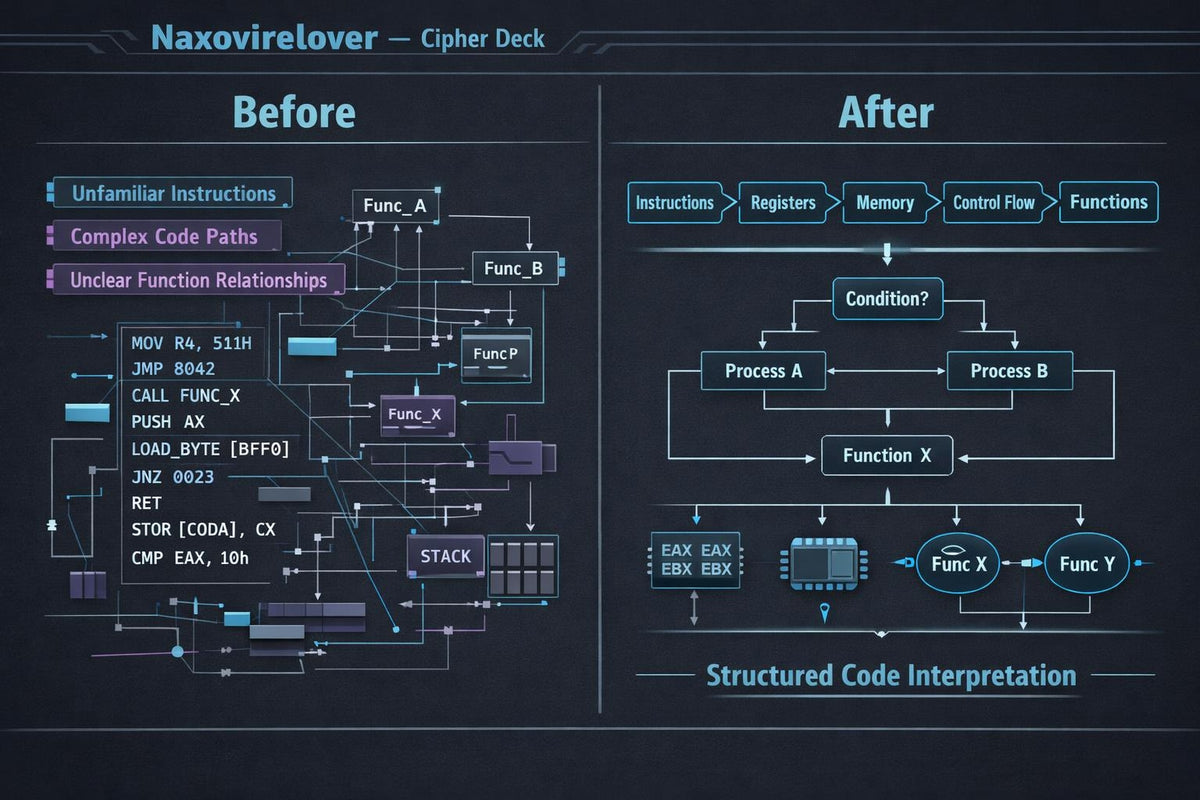
Understanding suspicious file characteristics and behavioral patterns provides an important foundation for malware investigation, but these observations do not always explain how unfamiliar programs operate internally.
Malicious software may contain complex instruction sequences, unusual control structures, and concealed functionality that cannot be fully understood through surface-level examination.
Learners often encounter difficulties when interpreting low-level instructions, recognizing program execution patterns, and connecting code structures with observable behavior.
Without an organized introduction to reverse engineering, analyzing unfamiliar program logic and documenting technical findings can become challenging.
Solution
Cipher Deck introduces the fundamental principles of malware reverse engineering through carefully structured educational modules.
The course explains how analysts examine program instructions, interpret control flow, and identify meaningful relationships between different code sections.
Learners explore simplified disassembly examples, study common instruction patterns, and investigate how program logic influences observable behavior.
Guided exercises demonstrate how to examine prepared code fragments, recognize suspicious operations, and organize technical observations.
The materials emphasize responsible analytical practices using fictional code examples and controlled educational scenarios.
What's Inside
Cipher Deck includes downloadable PDF educational materials covering:
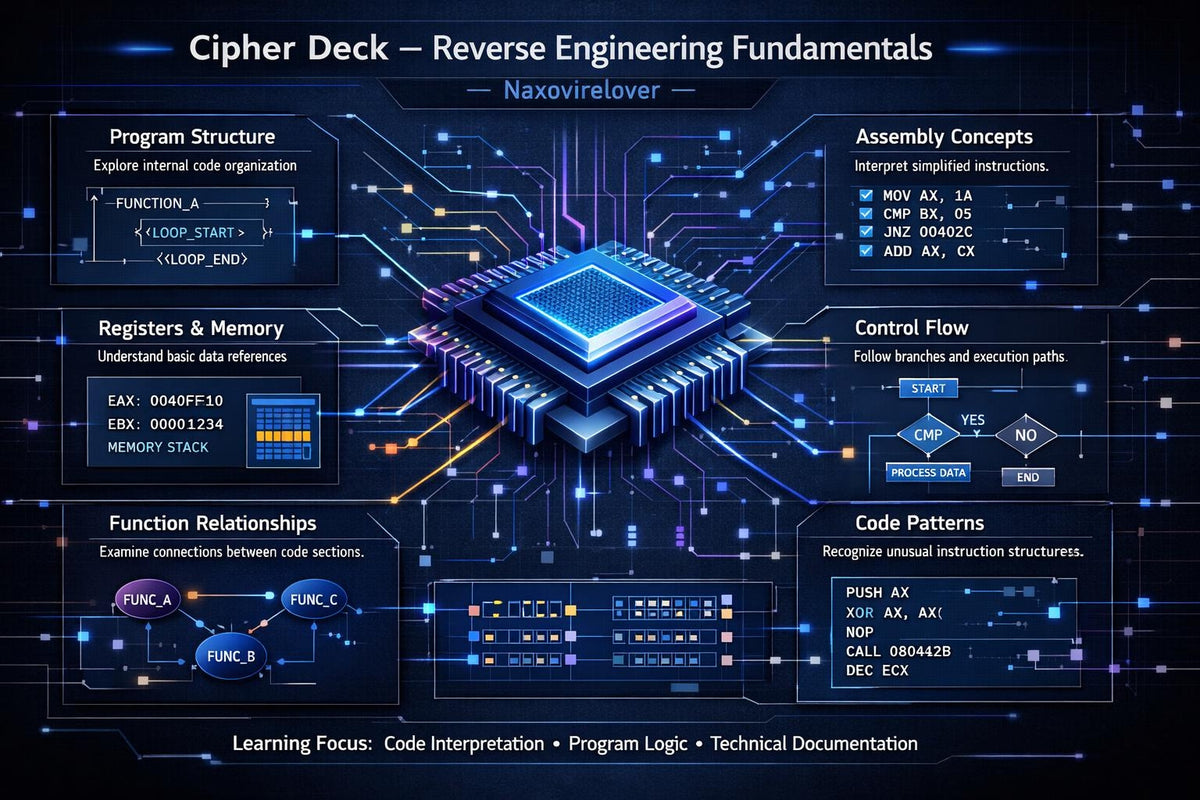
- Introduction to malware reverse engineering principles.
- Program structure and low-level instruction concepts.
- Assembly language fundamentals and instruction interpretation.
- Registers, memory references, and introductory data handling.
- Control flow, conditional branches, and function relationships.
- Disassembly concepts and simplified code examination.
- Suspicious instruction patterns and behavioral interpretation.
- Introduction to code obfuscation and analytical challenges.
- Reverse engineering documentation and investigation notes.
- Guided exercises, reference diagrams, and technical review questions.
Each module connects theoretical explanations with prepared examples intended for independent study.
Who Is This For?
Cipher Deck is intended for learners familiar with static and behavioral malware analysis who want to explore the internal structure of unfamiliar programs.
It is suitable for cybersecurity students, defensive security researchers, and independent learners interested in reverse engineering fundamentals.
Basic knowledge of program execution, memory concepts, and introductory programming terminology is recommended.
What You'll Learn
- Explain the purpose of reverse engineering in defensive malware analysis.
- Identify common low-level instruction categories.
- Interpret simplified assembly instruction sequences.
- Describe the role of registers and memory references.
- Recognize conditional branches and control flow structures.
- Examine function relationships in prepared code examples.
- Connect program instructions with observable behavioral indicators.
- Identify introductory obfuscation patterns.
- Distinguish documented code behavior from analytical assumptions.
- Organize reverse engineering observations into structured technical reports.
- Apply responsible investigation principles when examining unfamiliar code.
Guarantee
30-Day Money Back: Eligible course purchases may be refunded within 30 days according to our refund policy.
Risk-Free: Review the course details and applicable refund conditions before purchasing. Practical exercises use prepared educational code examples rather than requiring active malicious software.
Share
What is included in Naxovirelover courses?
What is included in Naxovirelover courses?
Our courses contain structured PDF learning materials focused on malware analysis and defensive cybersecurity investigation. Depending on the selected tier, the materials cover suspicious file examination, behavioral analysis, reverse engineering concepts, network traffic interpretation, threat intelligence, and incident reconstruction. Courses include educational explanations, practical examples, exercises, and a certificate of completion.
What format are the educational materials provided in?
What format are the educational materials provided in?
Our courses are delivered as downloadable PDF files containing written lessons, organized modules, technical explanations, diagrams, and educational exercises. The materials are designed for independent reading and practical study without requiring scheduled classes.
Do I need previous cybersecurity knowledge to begin?
Do I need previous cybersecurity knowledge to begin?
No previous cybersecurity experience is required for the introductory Free Kit. It explains foundational malware analysis terminology, file characteristics, and investigation principles. More detailed courses introduce technical subjects that may benefit from familiarity with earlier modules, programming concepts, and basic network terminology.